
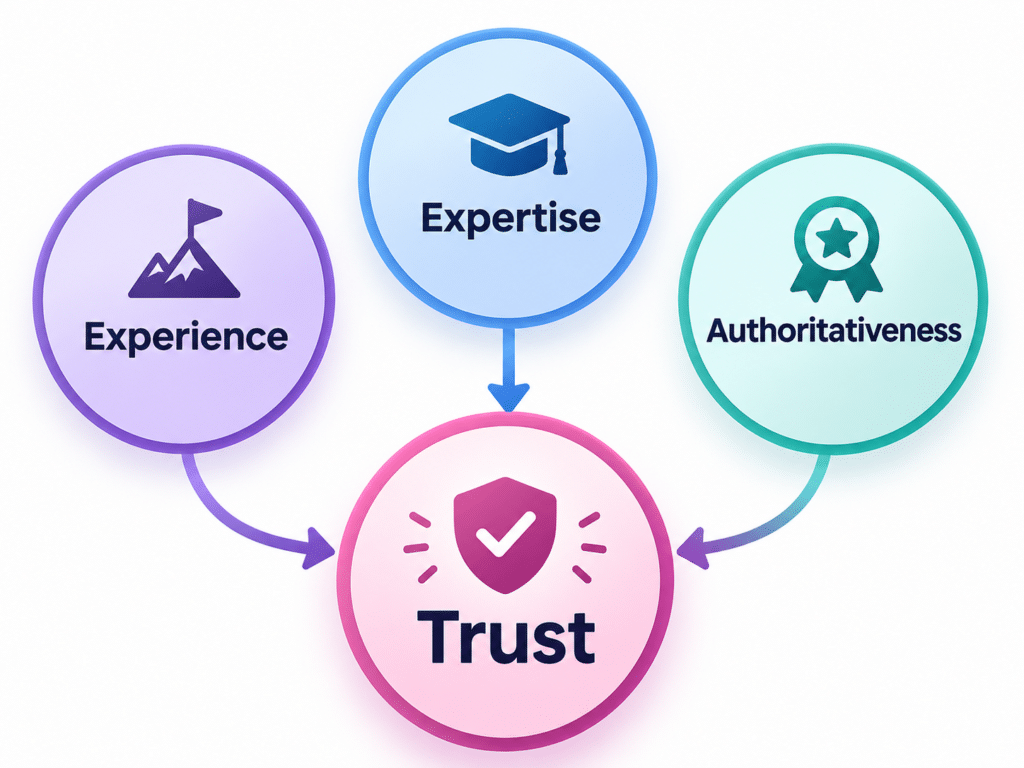
E-E-A-T is useful, but not directly a “Google score”.
Google describes E-E-A-T as experience, expertise, authoritativeness and trustworthiness, and explicitly says that trust is the most important of those aspects.
Google also explains that E-E-A-T itself is not a single specific ranking factor. Instead, many systems and signals can help identify content that demonstrates those qualities.
E-E-A-T
Experience
Does the content show real familiarity with the topic?
Product reviews, tutorials, case studies and practical advice are stronger when the reader can see evidence that the author has actually done the work.
Expertise
Does the creator have the knowledge needed for this particular topic?
Expertise can come from formal qualifications, professional work or deep practical knowledge depending on the subject.
Authoritativeness
Do other relevant people or sources recognize the site, author or brand?
Mentions, references, citations, links and a coherent body of work all contribute to authority.
Trust
Can a user reasonably believe the page and the entity behind it?
Accuracy, sourcing, authorship, transparent business information, secure transactions and clear policies all contribute.
How to review your website E-E-A-T practically
You can score your own site for workflow purposes, but call it an internal review score - not a Google score. Use it to identify missing evidence and trust signals.
| Area | Review question | Internal score |
| Authorship | Is the author clearly identified where readers would expect it? | 0 = Missing · 1 = Partial · 2 = Strong |
| Author context | Does the byline link to useful background or expertise? | 0 = Missing · 1 = Partial · 2 = Strong |
| First-hand evidence | Does the page show original examples, screenshots, process or experience? | 0 = Missing · 1 = Partial · 2 = Strong |
| Sources | Are important factual claims supported? | 0 = Missing · 1 = Partial · 2 = Strong |
| Accuracy | Is the content current and free of easily verifiable errors? | 0 = Missing · 1 = Partial · 2 = Strong |
| Business transparency | Can visitors find contact information, policies and commercial terms? | 0 = Missing · 1 = Partial · 2 = Strong |
| Site reputation | Are there relevant external mentions or references? | 0 = Missing · 1 = Partial · 2 = Strong |
| Purpose | Does the page actually satisfy the query instead of existing only to attract traffic? | 0 = Missing · 1 = Partial · 2 = Strong |
The number is only a prioritization device. For example, a 13/16 score does not mean Google sees “81% E-E-A-T.” It means your internal review found fewer obvious gaps than a 6/16 score page.
What not to do:
- Invent expert biographies or credentials.
- Add an author box that says nothing meaningful.
- Mass-produce “expert” quotes only to decorate thin content.
- Assume backlinks alone equal E-E-A-T.
- Treat an AI-generated trust score as a Google metric.
The best E-E-A-T work is usually not a trick.
It is clearer authorship, better evidence, accurate content, transparent business information, and a body of work people can verify.
Research and verification sources
See how ActionSEO works
ActionSEO brings website audits, page-level evidence, Google Search Console, GA4, tracked keywords and practical SEO workflows together so you can move from finding a problem to measuring what changed.