Free Page SEO Audit & Score
Scan one public URL with page-level SEO checks, technical signals, public link checks, schema detection, and Google PageSpeed Insights data when available.
How This Free SEO Audit Tool Works
The audit follows three steps:
- Enter your page URL, primary keyword, page intent, and domain rating range.
- The tool reviews the most important on-page and technical signals for that specific page.
- You receive a scored audit with prioritised recommendations, starting with what matters most.
No account required. No full-site crawl. No waiting for a report to load. This is designed for people who want to improve one important page, not manage a dashboard.
Domain Rating is optional. If you do not know yours, you can find it for free using Ahrefs' free domain checker or Moz's Link Explorer. Leave it blank, and the audit still runs in full.

What This SEO Audit Tool Checks
A strong on-page SEO audit looks beyond keywords. Search engines evaluate structure, clarity, relevance, technical accessibility, and user experience. This tool checks the signals that have the most direct impact on individual page performance.
Page Title
Your title tag is the single strongest on-page ranking signal. The tool checks whether your primary keyword appears near the beginning, whether the title length is within the recommended range, and whether it is likely to earn a click in search results.
Meta Description
Meta descriptions do not directly affect rankings, but they influence click-through rate. The tool checks whether yours is present, clear, and reinforces the page topic.
Heading Structure
A clear H1/H2/H3 hierarchy helps search engines understand the flow of information on your page. The tool checks whether your headings follow a logical order and whether your primary keyword appears in the right places.
Image Optimization
The tool checks whether images on your page have meaningful alt text and whether file names are descriptive. Missing alt text weakens both accessibility and relevance signals.
Readability, Open Graph Tags, and Schema
These signals support user experience, social sharing, and how search engines interpret your page. The tool includes them because they are often overlooked in basic page audits.
Keyword Relevance
The tool checks whether your primary keyword appears naturally in the title, headings, body content, and URL. Keyword relevance is about placement and context, not repetition.
Content Depth
Thin pages struggle in competitive search results. The tool assesses whether your page covers the topic with enough depth to satisfy what the searcher is actually looking for. This connects directly to search intent, which is why you are asked to specify it before running the audit.
Internal Links
Internal linking distributes authority across your site and signals topical relationships to search engines. The tool checks whether your page links to and from relevant content.
Technical SEO Basics
Technical issues can prevent a well-optimised page from performing in search. The tool checks for HTTPS, canonical signals, mobile readiness, structured data, and crawlability. For a deeper speed check, use Google PageSpeed Insights alongside this audit.
How to Read Your SEO Audit Score
Your score is a measure of how well your page follows established on-page best practices. It is a starting point for action, not a guarantee of rankings.
Score | What It Means | What to Do |
| 80 – 100 | Strong foundations | Focus on content quality and authority building |
| 60 – 79 | Meaningful gaps | Address the highest-priority issues before creating more content |
| Below 60 | Important signals missing | Prioritise structural and technical fixes first |
A low score does not mean the page cannot rank. It usually means there are improvements being missed that would make it easier to compete. Start with the items flagged as high priority in your results. Want to check your whole site, not just one page? Run full site audits and save your progress with ActionSEO.
How This Compares to Other SEO Audit Tools
Different tools serve different purposes. This one is built for focused, fast, single-page work, with no login required and no paid plan.
Tool | Best For | Requires Account? |
| Your SEO eBook audit tool | Fast single-page audit, no login | No |
| Semrush Site Audit | Full technical site crawls | Yes (paid) |
| Ahrefs SEO Checker | Sitewide issue discovery | Yes (paid) |
| Google Search Console | Search performance and indexing data | Yes (free, your site only) |
If your goal is to improve one priority page quickly, a focused page audit is often more practical than running a full site crawl and getting lost in hundreds of issues.
What to Fix After Your Page SEO Audit
An audit only becomes useful when it leads to action. Start with what has the biggest impact on your specific page.
For most pages, the highest-priority improvements are:
- Rewrite the title tag to front-load your primary keyword and make the benefit clear
- Strengthen the H1 so it matches search intent; not just the keyword
- Expand content depth where the page is thin or missing key information
- Add or improve internal links using descriptive anchor text
- Fix missing or generic image alt text
- Review search intent: make sure the page answers what the searcher actually wants
- Address any technical flags: canonical issues, HTTPS, mobile readiness
If you are not sure where to begin, the free 14-Day SEO Action Plan turns these priorities into a day-by-day workflow for one page.
→ Start with the free 14-Day SEO Action Plan
Alternatively, read our book for a complete guide and access to the 30-day SEO Action plan
You Have Your SEO Page Score. Now What?
Knowing what to fix is only half the picture. The harder part is understanding why each element matters and how to improve it without breaking what already works.
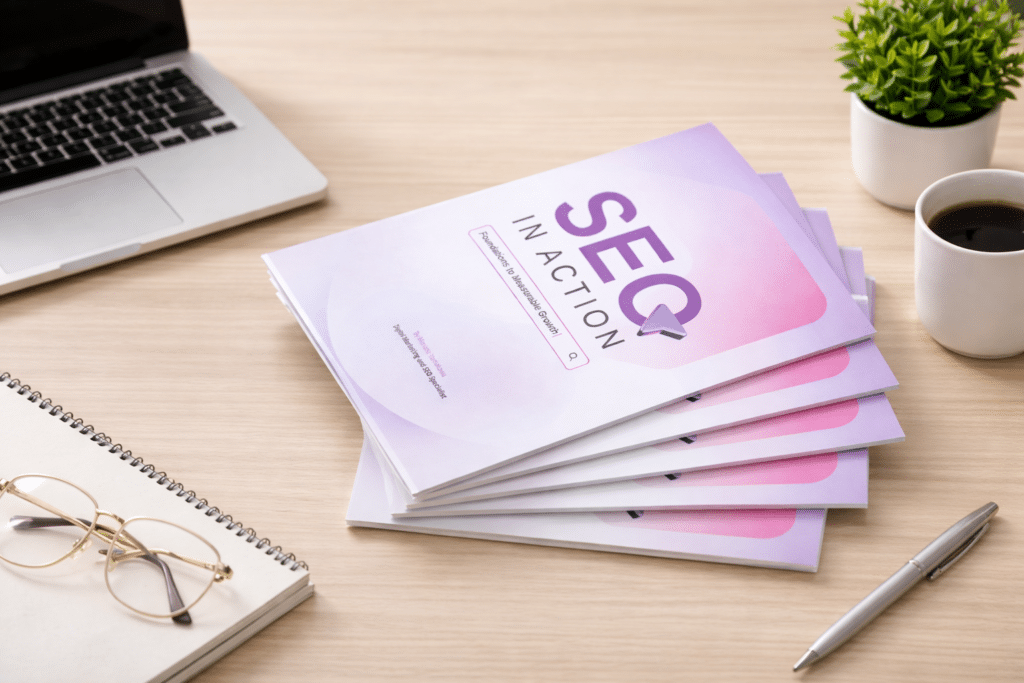
SEO in Action covers the full framework: on-page SEO, technical SEO, off-page authority, and analytics, with real examples, checklists, and step-by-step guidance built around how SEO actually gets implemented in practice.
It is the resource behind this tool and the next step after your audit if you want to go beyond a checklist. Learn the complete SEO in Action framework.
About This Tool
As a Digital Marketing and SEO Specialist, I have spent my last few years cutting through the noise. SEO in Action isn't a collection of blog posts, but the consolidated, battle-tested framework for building organic growth on WordPress.
This audit tool was built by Mariana Yamakawa, a Digital Marketing and SEO Specialist who has worked across agencies, in-house marketing teams, and as a small business owner. The scoring criteria are based on the same framework covered in SEO in Action, a practical guide built around what actually moves the needle for real pages, not theoretical best practice.
The tool is intentionally focused on single-page audits because that is how sustainable SEO improvement works: one page, one set of actions, measurable progress.
FAQs
A page SEO audit checks the elements most likely to affect how a single page performs in search results: title tag, meta description, heading structure, keyword placement, content depth, internal links, image alt text, HTTPS, mobile readiness, schema markup, and Open Graph tags.
An SEO audit score measures how well a page follows established on-page best practices. It identifies what is missing or weak, but it does not predict rankings. Rankings also depend on competition, domain authority, and how well the page matches search intent.
Pages scoring above 80 generally have strong technical and on-page foundations. Scores between 60 and 79 indicate meaningful gaps worth addressing. Pages below 60 usually have several high-priority issues that are worth fixing before investing in content creation or backlinks.
Semrush and Ahrefs audit entire websites and require paid accounts for full access. This tool audits a single page with no login, no account, and no cost, making it faster and more practical when your goal is improving one specific page.
No. Domain rating is optional. The tool runs a full on-page audit without it. If you want to include it, you can find your domain rating for free using Ahrefs' free domain checker or Moz's Link Explorer.
Audit any page before you update it and after you publish major changes. For pages that are part of an active SEO effort, once a month is a good habit. For new sites, auditing each page during the build phase saves time compared to fixing issues after launch.
Yes. A low score does not prevent a page from ranking. But improving the signals flagged in the audit, especially title, headings, content depth, and technical basics, usually increases the page's ability to compete, particularly in markets with moderate competition.
Continue Building Your SEO Foundation
→ Free 14-Day SEO Action Plan — turn your audit into a two-week workflow
→ SEO Checklist — a complete reference for on-page, technical, and off-page SEO
→ SEO Basics Guide — understand the framework before applying the tactics
→ SEO in Action — the full step-by-step guide behind this tool
→ Technical SEO for Beginners — the fixes flagged most often