Getting the click is not the same as earning the conversion.
A page can rank, attract the right query, and still lose the visitor in ten seconds because the site does not answer the next question: “Can I trust this?”
SEO often concentrates on visibility because visibility is measurable, but once a visitor lands, the page has a second job: to reduce uncertainty, Trust signals do that, and conversion signals tell the visitor what to do next.
Website Trust starts with clarity
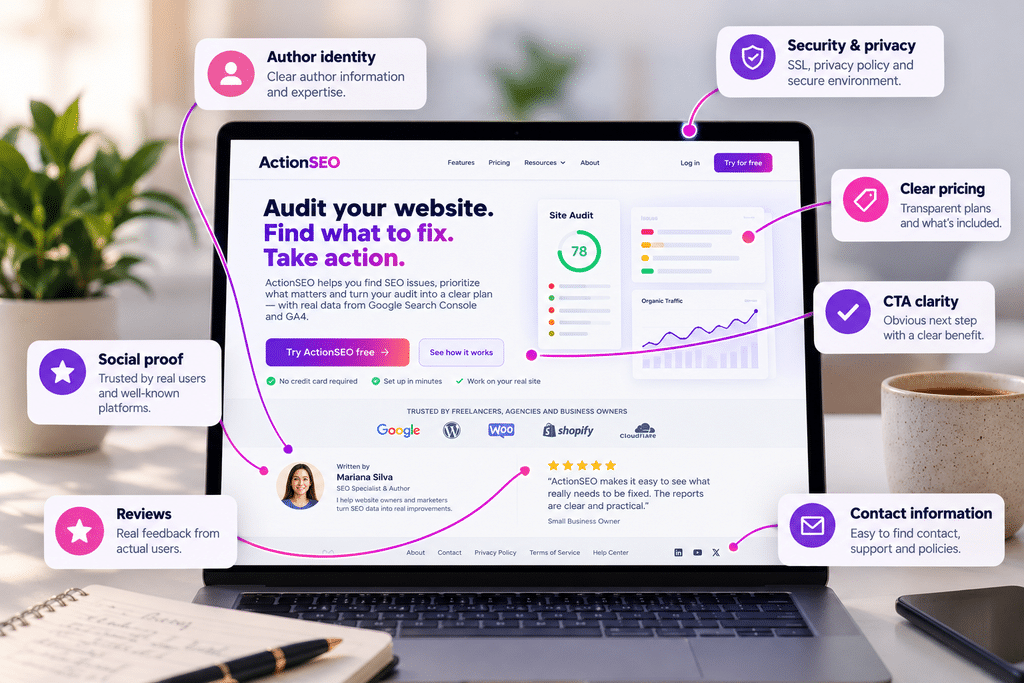
The fastest way to a website look untrustworthy is to make the visitor work out who you are, what you offer or what happens after they click. A clear navigation, a visible author or business identity, understandable pricing and specific claims are stronger than decorative “trust badges” with no context.
Show evidence where the claim is made
If you say a process works, show the process.
If you cite results, explain what the numbers represent.
If you compare tools, say what you tested or which official documentation you used.
Evidence close to the claim reduces the distance between promise and proof.
Make the next action proportionate
A visitor reading an educational blog post may not be ready for a hard purchase CTA, and a better next step might be a free audit, a checklist, a related guide or a trial. Conversion improves when the ask matches the reader’s stage.
Do not confuse social proof with trust
Reviews help, but only when they look real and relevant. For example, a vague testimonial is weaker than a specific one that explains the problem, what changed and who the customer is. The same applies to logos and badges: context matters.
Technical quality is part of trust
Broken forms, slow interactions, layout shifts, mixed pricing, dead links and inconsistent navigation all create doubt. Technical SEO and conversion are not separate universes when the technical issue changes how the user experiences the page.
Measure the behavior after the click
Use GA4 to review landing-page engagement and key events, and use Search Console to understand which queries are bringing those visitors. If a page has strong impressions and clicks but weak outcomes, the next SEO task may be conversion clarity rather than another keyword edit.
A quick trust-and-conversion review
- Is it obvious who created the page or owns the business?
- Does the page explain the offer before asking for the sale?
- Are important claims supported by examples, sources or proof?
- Is pricing clear where a buyer expects it?
- Can a visitor find privacy, terms and contact information?
- Is the CTA specific?
- Does the mobile version feel as credible as desktop?
- Do forms and checkout paths work without surprises?
Remember: SEO gets the right person to the door, but trust and conversion signals help them decide whether to walk through it.
If you only optimize the first half, you are measuring visibility while leaving the business result unfinished.
Start with a free audit
You don’t need to spend anything to find out where your site stands. Run a free SEO audit – get a score and a prioritized fix list in minutes. Then learn the full method in SEO in Action.
Written by Mariana Yamakawa, SEO specialist and author of SEO in Action.