
Ask a marketing team where their numbers come from, and you will usually get a confident answer. Ask them which of those numbers anyone can actually audit, and the room gets quieter. Search volumes are modeled by third-party databases. Keyword difficulty scores are proprietary formulas no one outside the vendor has seen. Social reach is self-reported by the platforms selling the ads. An uncomfortable share of modern marketing strategy is built on figures that are, in the most literal sense, estimates dressed as facts.
For years this was a tolerable compromise; the estimates were directionally useful and nothing better existed. In 2026, I would argue both halves of that sentence have stopped being true. The estimates are getting worse, and the verified alternatives are getting better. The teams that notice first are quietly rebuilding their measurement stack around a simple rule: report only what can be verified; use estimates only to form hypotheses, never to declare results.
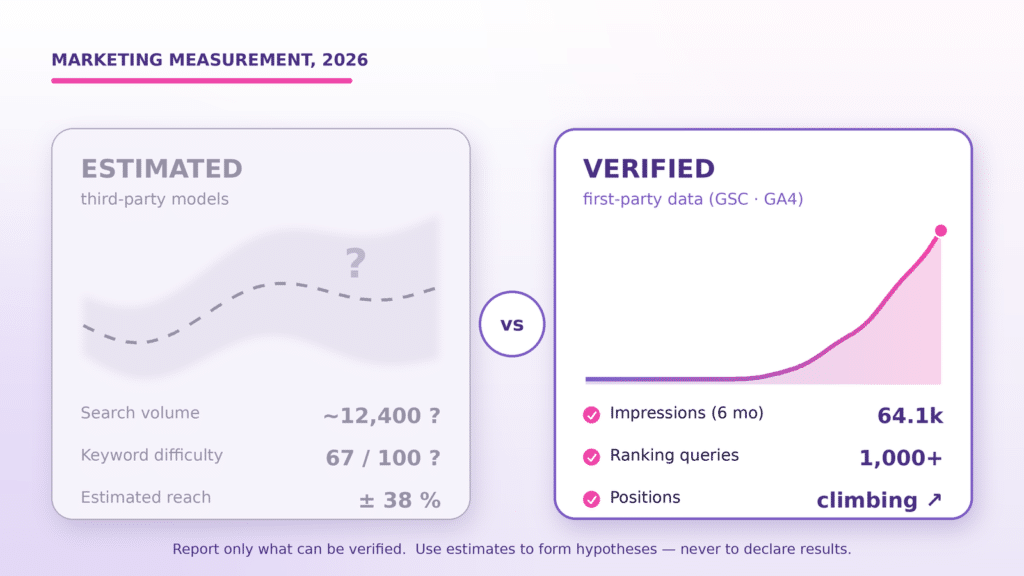
Why the estimates are degrading
Two forces are eroding third-party marketing data simultaneously. The first is the fragmentation of search itself: with AI-generated answers absorbing informational queries and discovery splintering across platforms, the clean click-stream data that volume models were built on no longer describes how people actually find things.
The second is scale bias: modeled metrics have always been least reliable exactly where most businesses live – smaller sites, niche topics, and non-English markets, where the underlying data samples are thinnest. The average estimate is calibrated for the average enterprise. Most companies are not that.
I saw this firsthand launching a new brand this year. As an SEO consultant building my own project – an SEO education site – I had every keyword tool available to me. Their guidance for my niche ranged from vague to actively misleading.
Then Google Search Console, which costs nothing and models nothing, told me something no vendor estimated: my new site was already surfacing for a major industry keyword with more than 5,700 recorded impressions, real appearances in front of real searchers, while sitting on page seven. No estimate flagged that demand for my domain. The verified data did not just measure my strategy; it set it. That page became my priority, because Google had already shown its hand.
The broader numbers told the same story. In three months, the site went from near-zero to over 1,000 verified impressions per day across more than 1,000 queries; this in the SEO industry itself, plausibly the most contested search vertical that exists, where every competitor is a ranking specialist by trade. And the curve keeps confirming itself: positions have been climbing steadily, and clicks are now following them, with roughly half of the site’s lifetime clicks arriving in the most recent thirty days. A growth story I could watch, audit, and attribute at every step, rather than infer from a vendor’s black box.
What a verified-data stack looks like
The principle travels well beyond SEO. Verified data is anything recorded by a system with direct knowledge of the event: Search Console for search visibility, GA4 for on-site behavior and revenue, your CRM for pipeline, platform-native conversion APIs for paid media, server logs for the ground truth beneath all of it. Estimated data – third-party volumes, difficulty scores, affinity audiences, modeled attribution – is not useless. It is a hypothesis generator. The discipline is refusing to let hypotheses appear in the same slide as results.
This sounds obvious written down. In practice, most reporting decks violate it weekly, because estimated numbers are usually bigger, smoother, and more flattering than verified ones. Verified data has an inconvenient honesty: it will tell a CMO that the celebrated content program is generating impressions but not clicks, or that the “high-difficulty” keyword the agency avoided is one the site already ranks for.
The brand-strategy dividend
There is a second-order effect that makes this more than a measurement hygiene issue. The same market forces punishing estimated data – AI-generated content floods, synthetic engagement, eroding attribution – are elevating verifiability into a brand attribute. Google’s quality frameworks now explicitly reward demonstrated first-hand experience. AI answer engines cite sources they can trust. Buyers, drowning in generated content, gravitate toward brands that show their receipts. A company whose public claims trace back to auditable data is building the same asset internally and externally: credibility that compounds.
Where to start on Monday
Begin with an audit, not a purchase. Take your last quarterly marketing report and mark every number as verified or estimated; the ratio will be clarifying. Then open the free tools you already own, most organizations use perhaps a tenth of what Search Console and GA4 record, and ask what they say about your strategy before renewing what the vendors say. Finally, change the reporting rule: estimates may inform bets, but only verified numbers may declare outcomes.
Marketing has spent two decades apologizing for being hard to measure, while quietly reporting numbers nobody could check. The tools to do better are free, and the competitive advantage of honesty is, for the moment, still unclaimed in most industries. That is the rarest thing a trend can be: early.



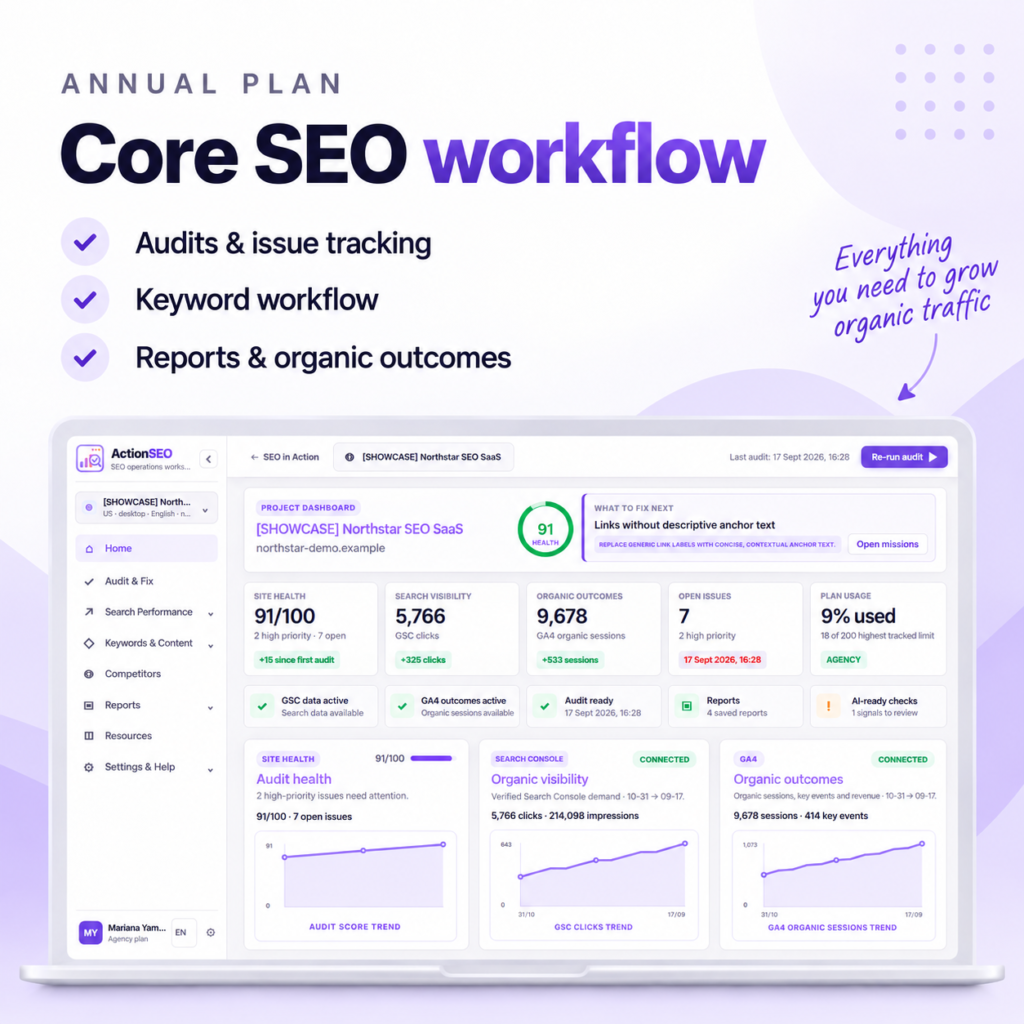

ActionSEO Agency Annual
For freelancers and agencies managing multiple client SEO projects.
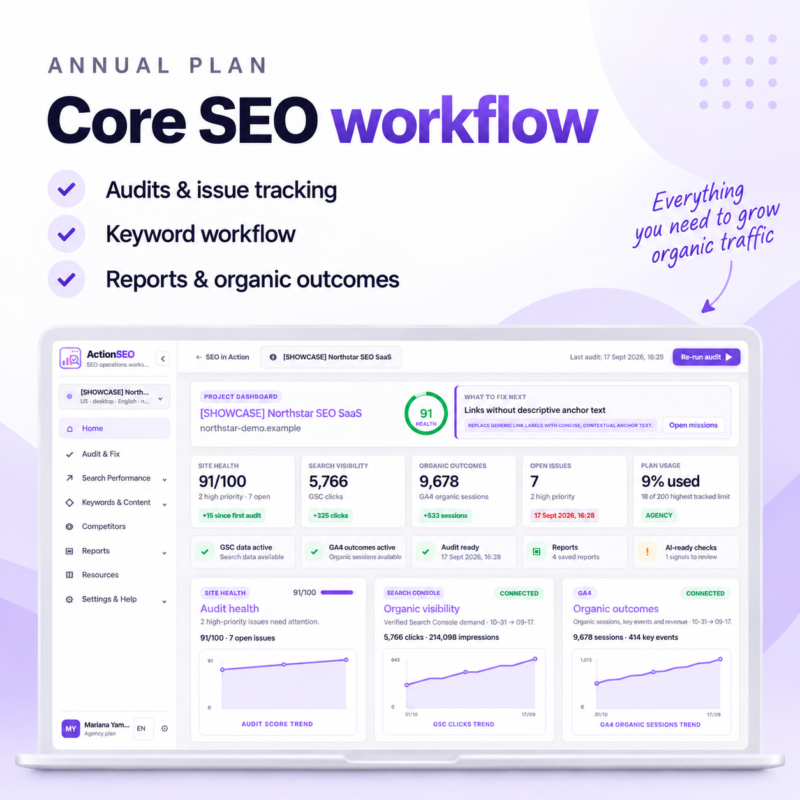
The Agency plan is built for users who need more projects, reports and client-facing workflow features. It helps you organise website audits, Google data, SEO actions and reporting across multiple client accounts.
- Up to 25 projects/domains
- Unlimited tracked keywords and saved competitors
- Agency workspace
- White-label reports
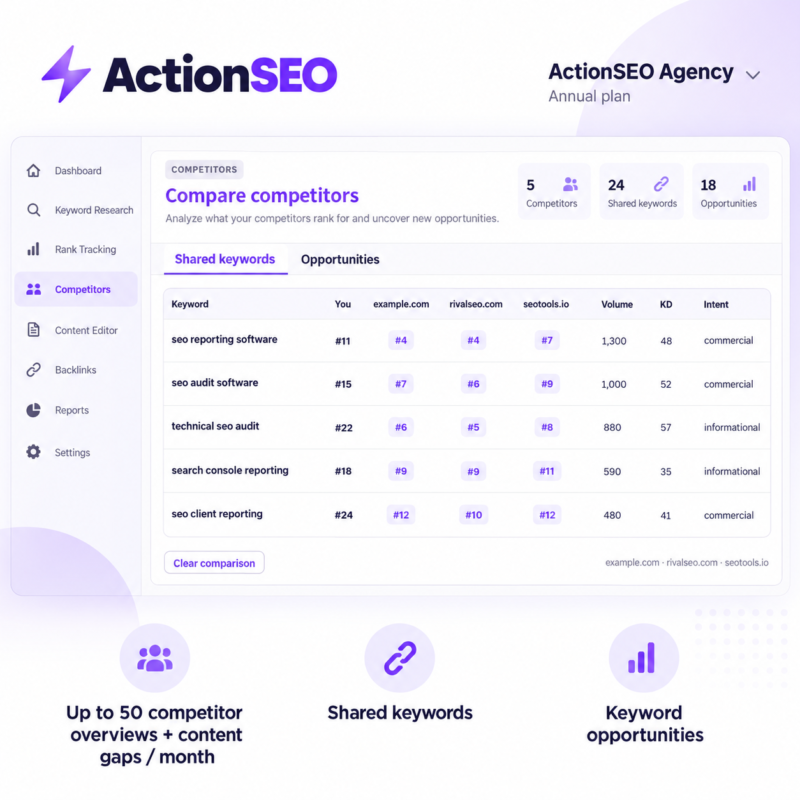
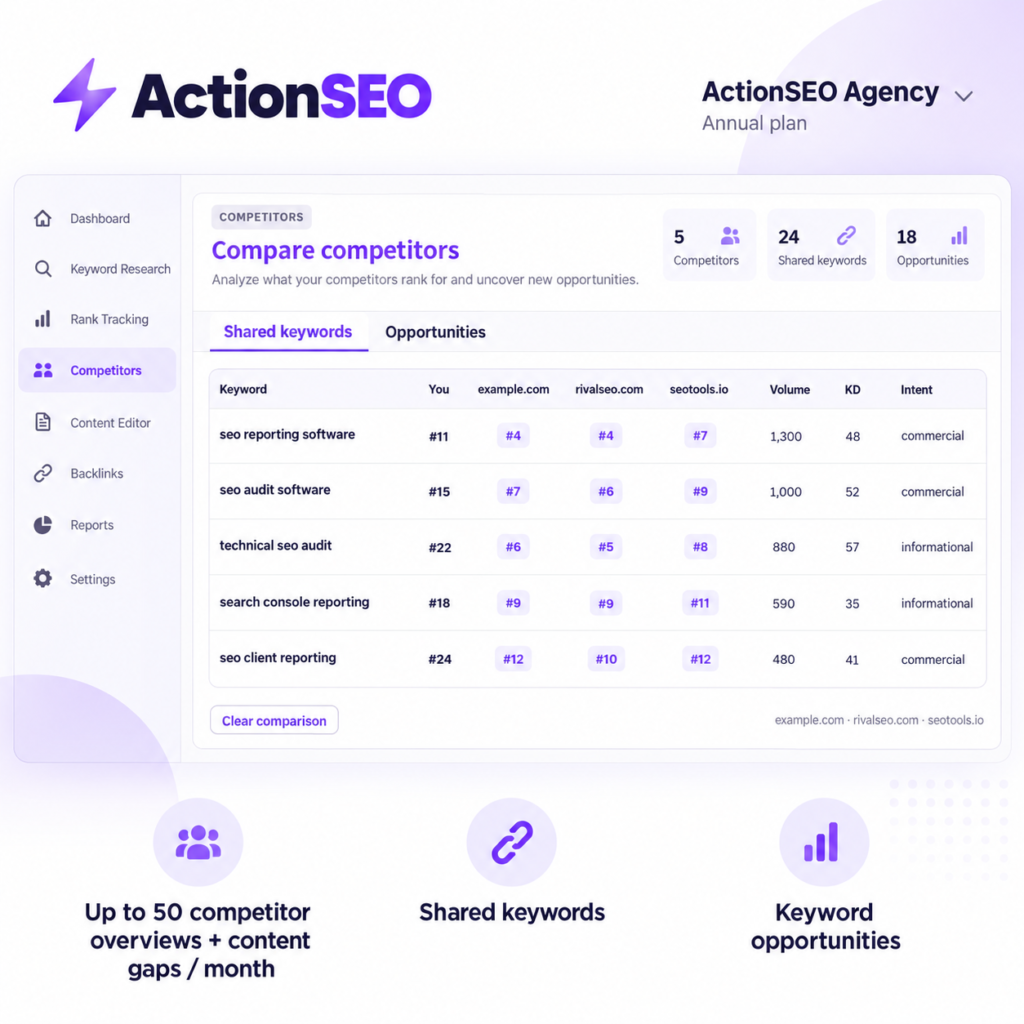
- Up to 50 competitor overviews + content gaps per month
- Owner + 4 collaborators + 5 client viewers